Basic Team Competition
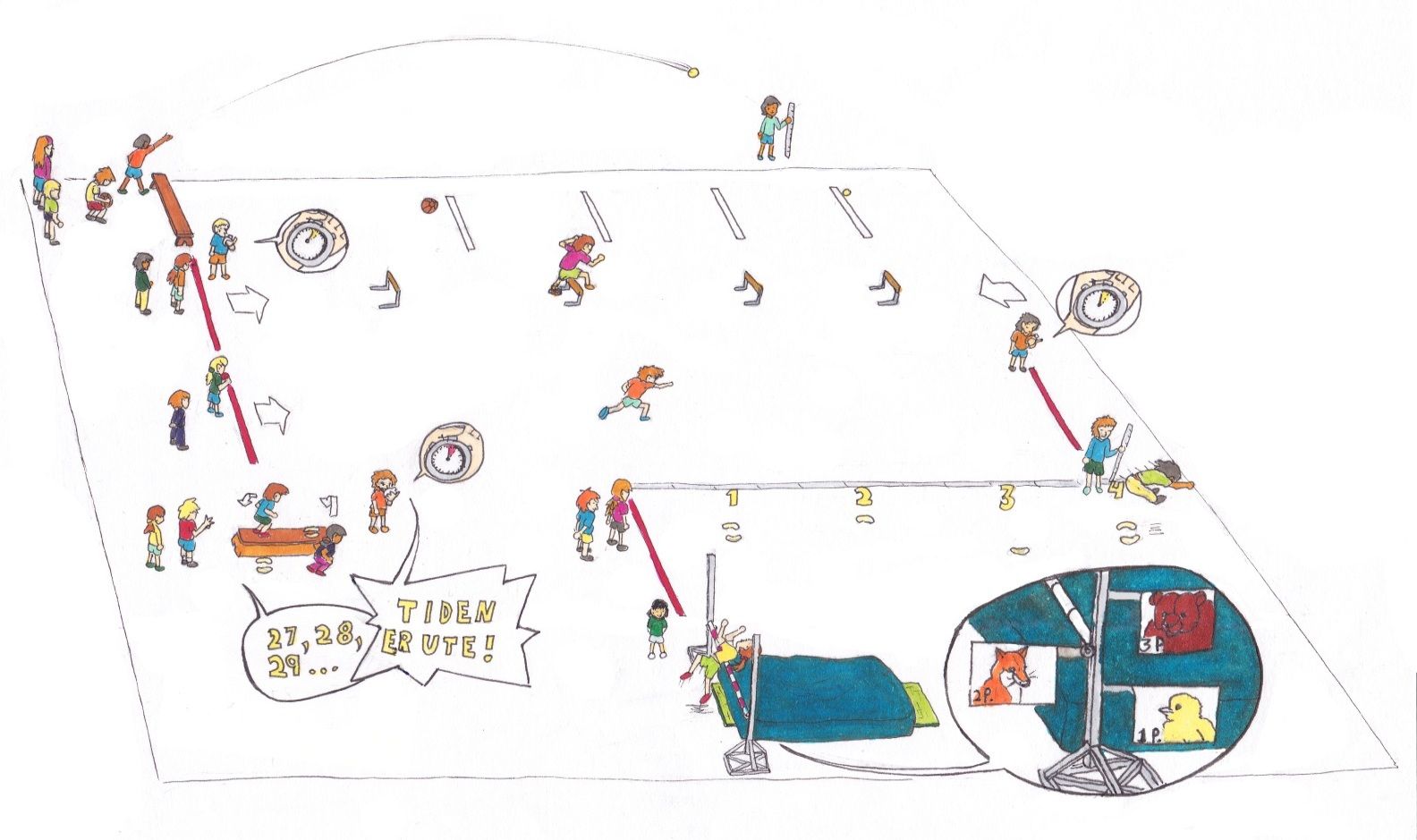
Train fundamental skills and develop social competence through cooperation, responsibility, communication, and fair play.
- 11+ years
- Group size: 10-60
- Duration: 40 min
- Competitive game
- Alternative physical activities
- Gym / Sports hall
- Open space
- Water
This team competition is an example of how to organize an activity where the participants are responsible themselves. Here, they will both lead the activity and measure each other's results. Divide into small teams of 2–4 people. The number of stations can vary based on time, space, and the goal of the session. The groups record their results on a pre-made form.
An important point is that all contributions count towards the team's total score. Even the one with the lowest score is significant for the result. In this way, differences in strength and performance level are leveled out, and everyone becomes important to the team.
Which exercises you choose depends on what you want to train; it doesn't have to be athletics.
Organization and Scoring System
This exercise requires some preparation. There are two suggestions for how to measure results and award points:
Fixed Point Scale
Determine in advance which results give different points, depending on whether one scores low, medium, or high.
Example (small ball throw):
- 7–11 m = 1 point
- 11–15 m = 2 points
- Over 15 m = 3 points
Images as Points
Distribute images that symbolize different performance levels.
Example:
- Low result: hen
- Medium result: fox
- High result: bear
Similar to alternative 1, it must be determined in advance which results correspond to which images. The goal, for example, could be to collect the most bears at the end. To make it exciting, a trade system could be used, for instance:
- 3 hens = 1 fox
- 3 foxes = 1 bear
This organizational format demands honesty, as the teams are responsible for measuring and recording their own results. At the same time, it provides good training in evaluating and registering the performance of others, and participants get to practice instructing and supporting each other.
Tip: Assemble the teams so that the competition is as even as possible. This organizational format can be used in all sports, including water activities.