Creative Dance 2
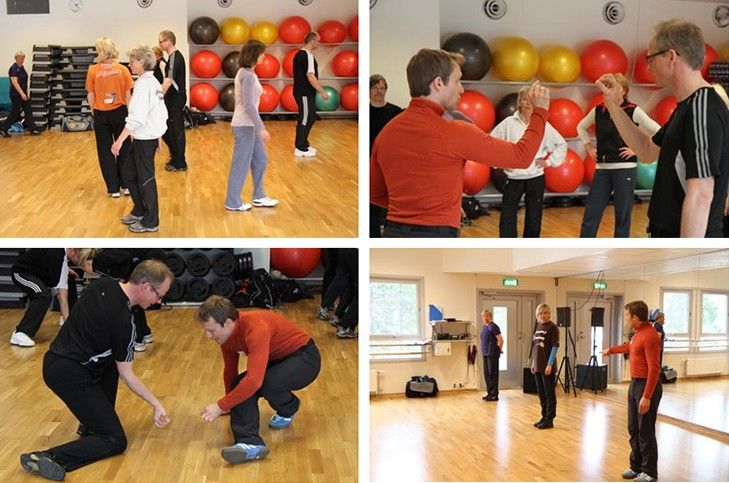
Warm-up and trust-building exercises for creative dance, focusing on spatial awareness.
- 10+ years
- Group size: 2+
- Duration: 30 min
- Dance
- Mountains, forests and fields
- Gym / Sports hall
- Indoor
- Open space
- Music
Here are five exercises that challenge participants' spatial awareness.
1. Close together – but not touching
One person in the group stands somewhere in the room. Everyone else should come as close to this person as possible, without touching either the person or each other.
Then the same person, or a new one, goes to a new spot in the room and stands there again, and the group should once again gather closely around. The person standing can decide how the others should approach them, for example:
- sideways
- backwards
- hopping
- running
- crawling, etc.
2. Equal distance
The group is divided into pairs. The pairs move freely around the room, but should always try to maintain approximately the same distance between them. The whole group can move wherever they want, but each pair focuses on maintaining their distance.
3. Staying in the middle
Three participants move together: two on the outside and one in the middle. The one in the middle should try to stay in the middle the entire time, while the other two move freely around the room.
The one in the middle must always:
- be in line with the other two
- have approximately equal distance to both
4. Thread / Imaginary Partner
a) Thread in pairs
Two people work together and imagine there's a 'thread' between them. They each hold an end and should move so that the thread is always taut – but without it 'breaking'.
If you have an actual thread, it can be used. If not, an imaginary thread can be used.
If you want softer and calmer movements, you can imagine it's cotton candy binding them together. Then the connection feels more 'vulnerable', and the quality of movement often becomes more sensitive and distinct.
b) Imaginary partner
Same task, but now: one person closes their eyes and moves as if the partner is still there; the other observes and is responsible for preventing collisions with others in the room.
5. Walk in straight lines
All participants should walk in straight lines on the floor towards a wall surface. When the leader says 'stop', they should turn 90 degrees to the right or left and continue walking in the new direction.
Each time the leader says 'stop', this is repeated: turn 90 degrees – move on. If they reach a wall, they should stand and wait there until the leader says 'stop' again and gives them the opportunity to turn.
Variation
- with or without music
- give specific focus:
- time/tempo (fast – slow)
- dynamics (powerful – soft movements)
- small vs. large movements
- contrasts (heavy/light, firm/fluid, etc.)
Use an inductive approach:
- let the dancers find solutions themselves based on their own perspective and conditions
- as a leader, you should primarily inspire exploration, give impulses, and open up possibilities – not 'show the right answer'
- adjust complexity, speed, and degree of contact according to the group's comfort and experience