Freerunning/Parkour
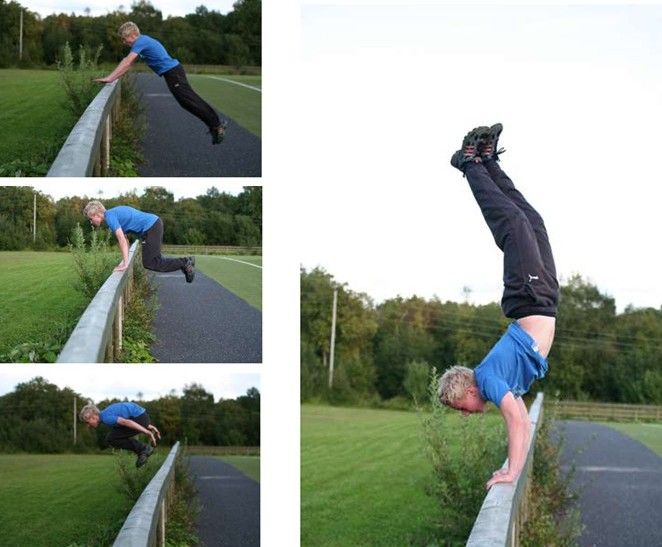
An exploratory activity that challenges the whole body and cognitive abilities.
- 6+ years
- Group size: 1+
- Duration: 45 min
- Alternative physical activities
- Mountains, forests and fields
- Open space
Find a natural obstacle in the school's local environment that participants should overcome. This could be benches, bike racks, equipment boxes, large stones, fences, etc. Only imagination and common sense set the limits.
First, let participants decide for themselves how they want to get over the obstacle. It can be a good idea to work in pairs, so they can try out ideas together. Afterwards, you can either show some good solutions yourself, or ask participants who have chosen appropriate methods to demonstrate. Focus on the most effective way to overcome the obstacle.
Once you have collectively found the most effective technique, everyone gets to try it multiple times. Then, the activity expands: participants will now perform a self-chosen «trick» while getting over the obstacle, and at this point, efficiency is not important. You can give examples, either by demonstrating or explaining - the trick can be anything, for example, an outstretched hand, a spin, a jump with legs together, or a somersault (where it is justifiable and well-secured).
Variation
The activity can be expanded in several ways:
- create a series of jumps in succession (a small 'course')
- use different obstacles with varying degrees of difficulty
- incorporate various tricks over each obstacle, here only imagination sets the limits
- let participants move over a longer distance and tackle obstacles that appear along the way, for example on a forest walk or a trip in the local area
- let participants film themselves, edit and add music, and show the films to the class or parents
Progression
- start with simple and low obstacles and gradually move to higher or more challenging obstacles
- introduce tricks only when the basic technique is safe
- let participants jump with different take-offs:
- left foot
- right foot
- both feet simultaneously
- set a time limit for how long one can be in contact with the obstacle, to promote quick and precise movements
- eventually, jumps can be combined into sequences (small parkour courses)
Adaptation possibilities and safety
- let participants contribute to suggesting and choosing obstacles
- choose obstacles that several people can use simultaneously, for example, a long row of bike racks
- let participants assess and discuss what is the most effective way to overcome the obstacle
- have a good warm-up before the activity
- always consider safety: assess both the surface and the height of the obstacles with regard to falls
- lawn, soft sand, or bog often provide good fall surfaces outdoors
- indoors, mats that are stable and don't slip can be used
- secure extra well if someone wants to try a somersault or other risky tricks from the obstacle
If the activity is new, a brief introduction to parkour/freerunning can increase motivation. The activity can advantageously be combined with other exercises in the same 'genre'.