Frisbee Discathon
Suggestions on how to use a Frisbee in a course.
- 14+ years
- Group size: 1+
- Duration: 40 min
- Alternative physical activities
- Mountains, forests and fields
- Open space
Mark a course where participants will throw a frisbee around. They can complete the course alone or in groups of 2–5 people. The length of the course is adapted to the area and can, for example, be between 100 and 1000 meters.
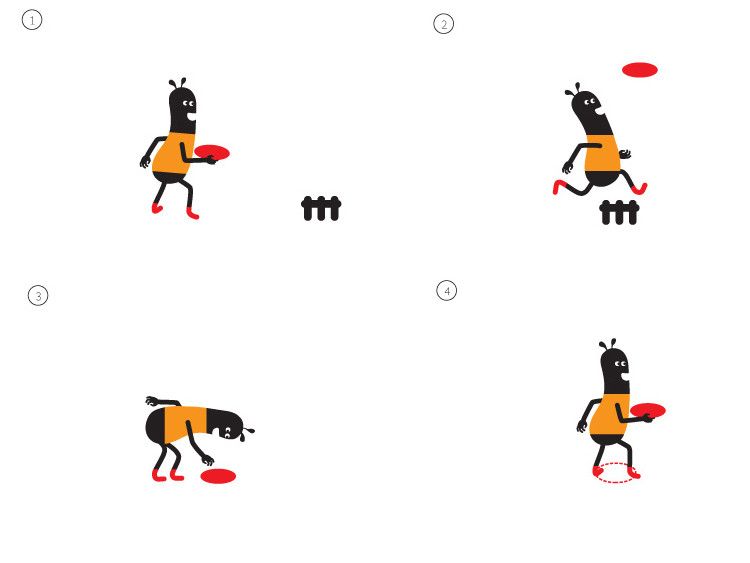
Feel free to use natural obstacles such as trees, lampposts, or buildings, and create 'gates' where the frisbee must pass on a specific side. Only the frisbee needs to pass through the gates – participants can run where it is most convenient. If you throw the frisbee in an arc around an obstacle, for example, you can run a shorter distance. The next throw should be taken from where the frisbee landed. When the frisbee has crossed the finish line, you're done.
It is not allowed to run with the frisbee in hand, nor is it allowed to deliberately obstruct other players. The activity can be varied by competing on time (who completes the course fastest) or on the number of throws (who uses the fewest throws throughout the course).
Design the course with both right and left turns, and with gates that must be passed. Have both short and long distances between the gates to allow for opportunities for long throws. The exercise also works well as a short indoor course.
Variation
The exercise can be organized in many ways:
- short course as an interval, where you run and throw multiple rounds
- relay with 2–3 participants per team, where the next participant starts when the first has crossed the finish line
- with technical limitations, for example:
- backhand throws only
- forehand throws only
- throwing with the 'wrong' hand
Progression
- Start without timing – the goal is just to get through the course.
- Have simple and wide gates at the start.
- As participants become more confident, the course can be redesigned with narrower and more challenging gates.
- Gradually increase the length of the course or introduce timing when the group masters the basic technique.