Memory Relay
Especially suitable for subjects where memorization is required to learn the content. Develops cognitive skills.
- 3+ years
- Group size: 2+
- Duration: 20 min
- Alternative physical activities
- Relay
- Physically Active Learning
- Mountains, forests and fields
- Gym / Sports hall
- Indoor
- Snow / ice
- Open space
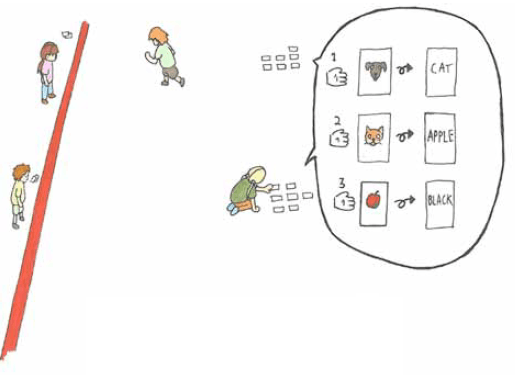
A playful activity where various basic skills are trained using playing cards. Can be used in all subjects and at all levels where the goal is to acquire new knowledge. The memory cards consist of laminated sheets with a question/answer on each side. The question and answer do not belong together on the same card; the answer to one question is found on another card. Only when all the cards have been collected can one see if the tasks have been solved correctly: The back of the first card picked up should then match the question on the last card.
Preparation
Lay the cards face up on the floor. Create one card pile per team, with some distance between the piles. Participants line up behind a starting line some distance away and wait for the start signal.
How to Play
The first participant runs forward and picks up a random card, takes it back to the team, shows the «backside» of the card to the next person on the team (this is where the task this person needs to solve by picking up the correct card is written), and then places the card on the ground by the starting line (with the opposite side up from the one that was on top of the pile).
The next participant retrieves the card that provides the correct answer to / matches the task on the first card, shows the backside to the next person on the team, and places the card on top of the first one (with the same side up).
When all cards have been collected and are in a stack, the team can check if everything is correct by verifying if the task on the last card matches the answer on the first.
Variation
This organizational format can be used in kindergartens (with pictures/symbols) and in all school subjects, for example, for learning the alphabet, addition and subtraction, fractions, countries and capitals, etc. One can work individually or in teams, preferably as a relay race. The number of cards can be varied depending on how challenging the session should be.
Progression
The activity can be carried out calmly at a table or as a movement activity individually, in pairs, or in groups. Instead of running to retrieve the cards, other forms of movement can be used, such as walking backward, jumping, hopping, or crawling. The choice of subject content and movement form determines who the activity is suitable for.