Parts of Speech Relay Race
Practice distinguishing between different parts of speech, expanding vocabulary through physical activity.
- 10-15 years
- Group size: 4+
- Duration: 20 min
- Relay
- Physically Active Learning
- Gym / Sports hall
- Open space
- Indoor
- Bean bags
- Chalk
- Bags
Divide participants into groups of 4–5 people. Each group receives beanbags for throwing, as well as paper and writing utensils. Create a starting line and draw a circle for each group 6–7 meters from the line. The circles should have a diameter of approx. 1 meter. Divide each circle into four equal sections and mark them with:
- «verb»
- «noun»
- «adjective»
- «preposition»
Assign one movement to each part of speech:
- Verb: hop on one leg
- Noun: walk with giant strides like an elephant
- Adjective: jog backward
- Preposition: jump with feet together
The groups line up behind the starting line. The first participant in each group throws the beanbag towards the circle and runs out to see which section it landed in. If the beanbag lands outside the circle, it must be retrieved and thrown again. Then the participant throws the beanbag back to the next person on the team, but they cannot start until the first person has moved back to the starting line using the movement corresponding to the part of speech where the beanbag landed.
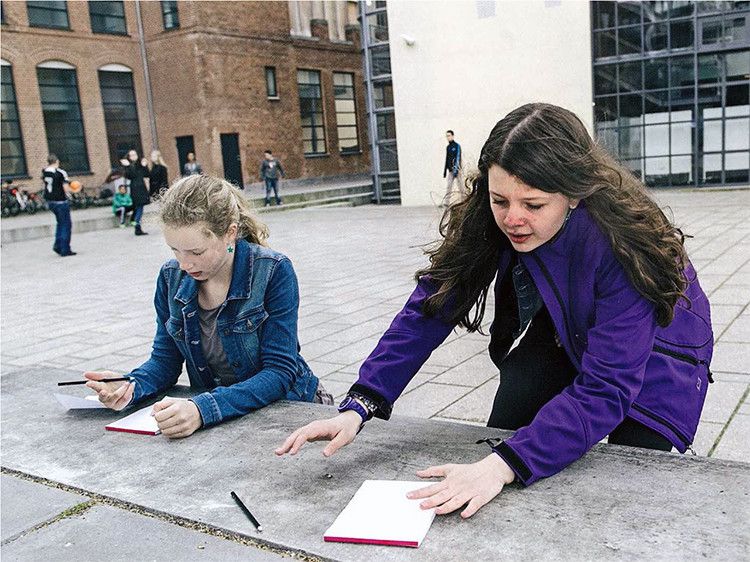
Once the participant is back, the group must collaboratively find a word in the relevant part of speech and write it down. The relay continues in this manner. After an agreed-upon time, for example 10 minutes, the groups try to create as many sentences as possible using the words they have written down. The group with the most sentences wins. Here, it's not necessarily the fastest runners or the best throwers who win.
Variations
- The relay can be carried out in all language subjects.
- The sections can represent other categories, for example, gender, case, or degrees of comparison.
- Reduce the throwing distance for participants who struggle with throwing.
- If someone has difficulty running to and from the circles, others on the team can be 'runners' for them.