Polonaise March
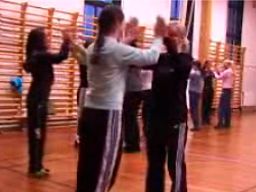
Suggestions for various 'figures' or 'moves' one can perform in a polonaise.
- 6+ years
- Group size: 6+
- Duration: 20 min
- Dance
- Mountains, forests and fields
- Gym / Sports hall
- Indoor
- Open space
- Music
Here, participants line up in pairs, one after another in a row, with a 'light hold' (simple handgrip).
The steps danced are walking steps, with an emphasis on marching and keeping time.
Explanation – various figures in Polonaise
- The couples walk half a round around the hall and into the middle of the room. They say goodbye, and the lines separate, going down each side of the hall.
- Down in the hall, the couples cross past each other: the girls innermost the first time, the boys innermost the next time. At the next meeting, they greet each other, take hands, and walk up the middle of the hall again.
- The couples go to their respective sides (alternating right and left). When they meet again, they greet each other and walk together in fours. If there are many dancers, one can do the same but go up in groups of two couples (eight people).
- The first line takes a 'shoulder hold' (hands on shoulders), and walks between the others, who 'hook on' gradually. A 'knot' is formed, then untangled, and they walk two by two around the hall again until everyone is standing in pairs in a row.
- The first couple joins hands and forms a tunnel. The other couples pass through and extend the tunnel. Then, they go through the tunnel once more and march on until everyone is again in a line.
- The first couple takes hands, turns, and walks in the opposite direction down the 'passageway'. The others bend down, go through, and follow – until the line is fully stretched out.
- The first couple turns, takes each other by the opposite hand, and 'weaves' their way under and over the other couples. The others follow. It's important that the couple starting the weaving determines the pattern (under-over) to avoid chaos.
- The couples walk normally two by two. They release each other, move out to their respective sides, and stand clapping their hands. The other couples pass by and do the same – eventually forming a long corridor.
- The couples take hands and hop sideways through the corridor, extending it further. Here, new variations can be invented: hopping in different ways, carrying each other, creating small figures, etc. Finally, the couples can walk arm in arm and wave to the others.
- The couples again walk in pairs in a line. The first couple takes both hands, squats close to each other, sways gently up and down to the music, and hums. The others follow: they take each other's hands, go to the outside, and sit down close to the next couple. When everyone is seated, the first couple pushes the line over – 'Dominoras'!
About Polonaise
Dancing the Polonaise is suitable for all ages and is still widely used in festive gatherings. Mixed-age groups are welcome here. Choose figures that the group can master, and find one couple to lead the Polonaise. The others follow the leading couple, who give clear 'signals' to those behind.
Polonaise is great to use at larger gatherings in schools and kindergartens – such as parent parties, school proms, and similar events. It can also be fun to go in and out of different rooms, or take a walk outdoors as part of the Polonaise.