Parisian Polka
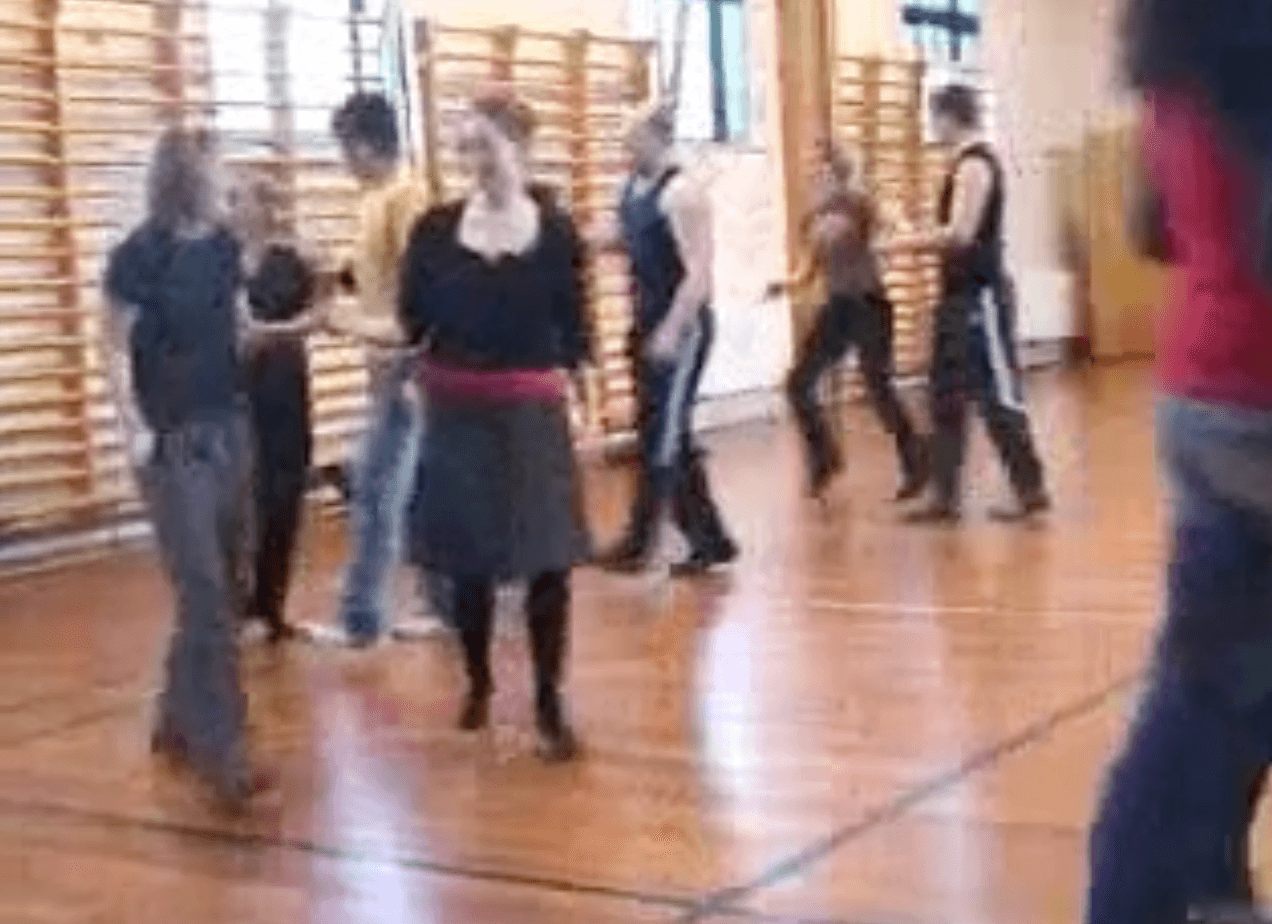
The dance is performed in pairs in a large circle with a simple handhold, facing clockwise. The gentleman has the lady on his right side.
- 8+ years
- Group size: 2+
- Duration: 20 min
- Folk game
- Dance
- Open space
- Gym / Sports hall
- Indoor
How to do it
The steps for a dancer are walking steps and change-of-foot steps.
Explanation First figure:
a) The pairs take three steps forward, facing each other, and place their foot next to the other on 4 (1-4) (Both start with the outer foot). Repeat back to the starting point. (1-4)
b) Take two change-of-foot steps forward in the direction of the dance. (1-4) (Both start with the outer foot).
c) The boy holds the girl around the waist, the girl places her hands on the boy's shoulders. (1-4) Turn around twice on 1-2-3-4. It's important to start the turning early. Repeat the dance from the beginning and learn the first figure well before moving on to the next figures.
The Parisian Polka is often danced with only this figure.
Variation for the first figure: Part a) should be danced similarly, but instead of placing the foot next to the other on 4, one swings it over the other foot and claps hands at the same time.
Explanation Second figure:
a) The pairs take three steps forward while turning away from each other. (The boy turns left, the girl turns right). On 4, they place their foot next to the other and clap hands at the same time. (1-4) Repeat back to the starting point (Boy to the right, girl to the right). (1-4)
b) As in the first figure. (1-4)
c) As in the first figure. (1-4)
Explanation Third figure:
a) The pairs take each other's hands and go under their arms while taking three steps forward. On 4, they place their foot next to the other (1-4). Repeat back to the starting point. (1-4)
b) As in the first and second figure. (1-4)
c) As in the first and second figure. (1-4)
Progression
The first figure in this dance can be simplified so that even the youngest children can dance it. Instead of change-of-foot steps, walking steps are used. When turning, pairs can hold hands and turn only once. It is easiest to stand in pairs in a line when learning the dance. Once the figures are practiced, one can move in a circle. It is important to emphasize that the leader (the boy) quickly enters the turn and that one walks around (not jumps).
Provided by Liv Ingrid Grov/National Centre for Food, Health and Physical Activity