Creative Dance 1
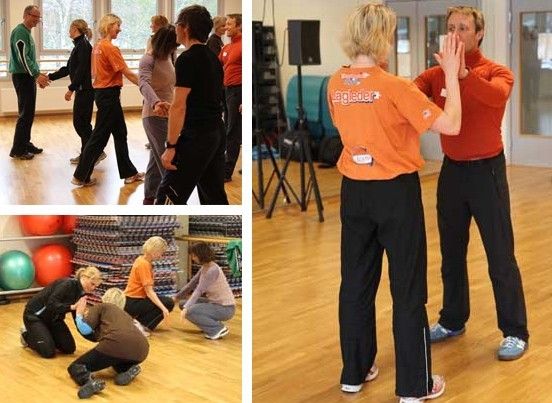
Warm-up and trust-building exercises for creative dance, focusing on body awareness.
- 10+ years
- Group size: 4+
- Duration: 20 min
- Dance
- Gym / Sports hall
- Mountains, forests and fields
- Indoor
- Open space
- Music
The dancers move together in a cluster and greet each other – preferably to music. Along the way, you introduce new ways to greet.
Examples:
- first a regular handshake
- then 'greet with' a shoulder
- then knee, back, elbow, etc.
Let them spend some time on each method. The exercise can be extended, for example, by having them lie down on the floor between each person they greet.
Once they have greeted for a while and are starting to feel comfortable, they get new tasks. The first could be to find different ways of walking. The dancers move freely in the room, while you give keywords for different walking styles, for example:
- walk like an elephant (heavy)
- like a child who has just learned to walk (staccato)
- as if walking on thin ice (light, careful steps)
- like a ballet dancer (flowing and soft)
After they have experimented for a while, you can give new challenges, such as:
“Can you continue to walk, but use all three levels, high, medium, and low?”
- time and tempo (fast/slow)
- dynamics (powerful/soft movements)
- small and large movements
- contrasts (heavy/light, abrupt/flowing, etc.)
Feel free to use varied music to inspire different movement qualities.
Variation
- with or without music
- specific focus tasks: time/tempo, dynamics, size of movements, contrasts, etc.
Suggested exercises in pairs
- Give and take balance: From a standing position, the pair finds a common balance point and gradually increases pressure against their partner (from 0–100–0). The exercise is done both facing each other and with backs to each other.
- Mirror movement: One person makes movements, the other imitates.
Can be done at a great distance, using the entire room, and with or without music.
Opposite mirror: One person leads the movement, the other should do the opposite (up becomes down, right becomes left). This is a natural progression from regular mirror movement.
Work with an inductive approach:
- let the dancers find solutions based on their own abilities
- avoid dictating movements – as a leader, you should inspire, give impulses, and open up for exploration
- adjust the amount of support and concrete examples according to the group's confidence and experience.