Dice Relay
Playful endurance training focusing on cognitive skills.
- 3-14 years
- Group size: 6+
- Duration: 20 min
- Relay
- Gym / Sports hall
- Snow / ice
- Water
- Open space
- Dice
- Cones
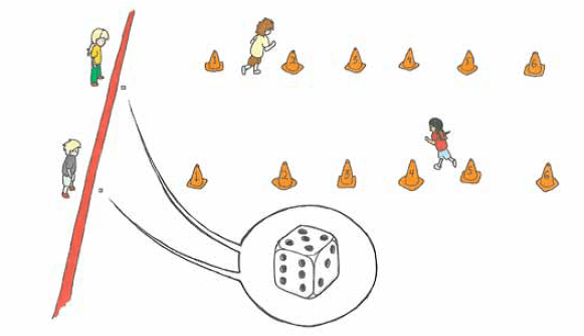
Divide the group into two or more teams with up to four people on each team. The first person on each team rolls the dice, runs to the cone that corresponds to the number of pips on the dice, runs back and tags the next person, who then rolls the dice, and so on. The dice is used as the baton, so the next runner cannot roll until the current runner has returned. Agree in advance how many rounds the team will run in total. The team that first completes the agreed number of rounds wins.
Tip: Make a mark on the ground each time the person/team has run, to keep track.
Variations
- Vary the distance or number of cones.
- Use different forms of movement, with or without a ball, to create motor variation.
- One variation is that each team has six people, and the number of people running each time should correspond to the number of pips on the dice.
- Participants can be tasked with running, for example, two more than what the dice shows. The track must then be extended to cover possible answers.
- Addition or subtraction with two dice provides opportunities for new rules.
- For subtraction, two dice with different numerical symbols can be used, and the difference is the largest number minus the smallest number. The entire equation should be said aloud, for example: 'six minus two equals four'.
- Start with a given number that is greater than the highest number on the dice. The running and saying the answer aloud then expresses the difference between this number and the number of pips on the dice, for example: 'ten minus four is six'.
- The concept of multiplication can be challenged by, for example, doubling the number of pips minus 1, etc. The number of cones must then be adapted so that all possible outcomes are covered.
The first team to reach/hit a certain total sum (e.g., 50) wins.
The exercise is also well-suited for skiing, skating, and in the swimming pool.