Balance Skills
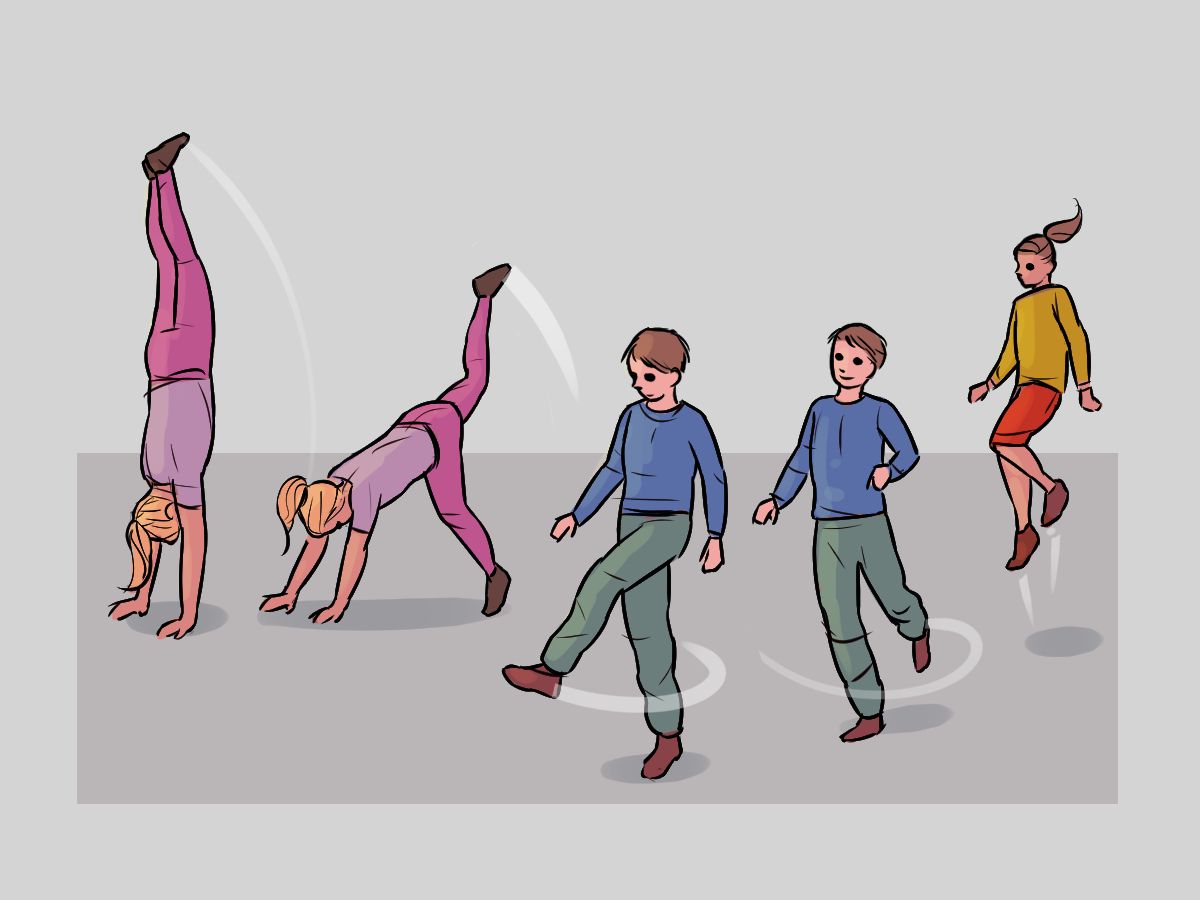
Examples of exercises that challenge balance.
- 10+ years
- Group size: 1+
- Duration: 30 min
- Alternative physical activities
- Gym / Sports hall
- Indoor
- Open space
If the body is in balance before a movement, the whole body will cooperate to perform it. If it's out of balance, one must simultaneously work to regain balance while the movement is executed. This is easy to explain but challenging in practice if one doesn't have a conscious focus on balance. When balance is challenged and trained, the body becomes more present in its own movements.
The exercises below are good examples of balance-challenging training:
- Rotation on one foot
- Handstand
- Single-leg squat
Rotation on One Foot
Execution: Stand on one leg, with the other leg free. Rotate the free leg controlled from one side of the body to the other. The movement should come from the hip. Avoid rotating all the way around – focus on controlled movement back and forth.
Purpose: The exercise challenges balance, coordination, and stabilizing strength.
Progression:
- Hold arms out to the side for better control
- Keep the standing foot completely still throughout the movement
- Increase the difficulty by:
Handstand
Execution: Start by placing your hands on the ground approximately shoulder-width apart. Bend the front leg, and use the back leg to swing up towards a wall, or get help from a partner to spot you. When you get into a handstand, bring your legs together, fully extend your shoulders, and keep tension in your core and back to stabilize.
Note! Handstands stress the wrists and shoulders and require a good warm-up. Acclimatization should happen gradually, and the exercise should not be held for too long at a time initially.
Purpose: The exercise challenges strength in the shoulders, core, and back, while also requiring balance to be maintained on the hands.
Progression:
- Look down at your hands and try to find balance without wall support
- Once you are confident, try standing in a handstand with closed eyes
Single-Leg Squat
Execution: Stand on one leg, with the free leg either behind, in front, or to the side. Slowly lower yourself into a squat on the standing leg. By keeping your back straight, the depth of the squat will regulate itself.
Purpose: The exercise challenges balance, relative strength, and mobility in the lower back and hips.
Progression:
- Start with support from a wall or other stable surface
- Once you master the movement, you can:
Balance ability, like stabilization ability, is fundamental in all activity. Good balance in a movement gives the participant time and space to:
- change direction or form of movement
- set pace and intensity
- handle unexpected situations without losing control