Kin-ball
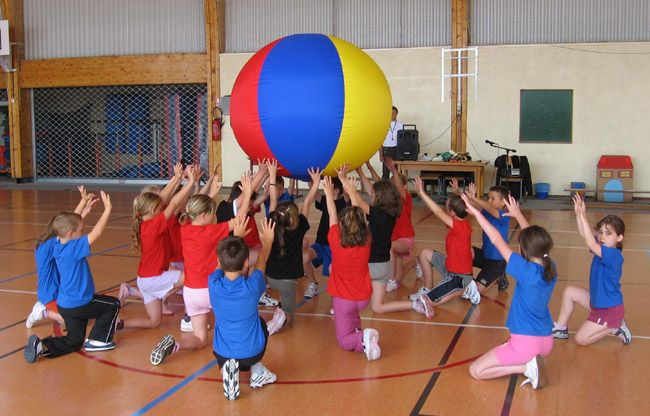
KIN-BALL is all about teamwork, inclusion and fair play.
- 11+ years
- Group size: 12+
- Duration: 30 min
- Ball sport
- Open space
- Gym / Sports hall
- Ball
- Mesh vests
KIN-BALL is a lightweight ball. To make the ball so large and light, it does not have a traditional inner tube, but a thin latex bladder. The ball is essentially like a balloon with a nylon cover. Choose a brightly coloured ball that is easy for everyone to see.
How to play KIN-BALL
A huge and very light ball is at the centre of the game, which consists of 3 teams, each with 4 players. When the ball is served, everyone on the team must be in contact with the ball. Players take turns serving so that everyone gets a chance to participate.
KIN-BALL is played with three teams of four players. Each team has its own colour. The official court size is 21.40 x 21.40 m.
The starting position for the serve is that the other two teams form four corners around the team serving. One player from each team in each corner.
Before the ball is served, the server must shout ‘OMNIKIN!’ – and the colour of one of the other teams. The ball must be served so that it has an upward trajectory and travels at least 2 metres. The ball may be hit or pushed with both hands.
The other three team members hold the ball aloft, ready for the serve. The four team members take turns serving. If the same player serves twice in a row, it counts as a fault and the other two teams are awarded a point. The team must serve within 10 seconds; otherwise, the team is awarded a fault and a point to the other team. It is not permitted to hit the ball out of the court or against the wall.
When a team is called, the team must try to catch the ball before it touches the ground. The ball may be caught by one or more players on the team using any part of the body. As long as only one or two players touch the ball, the team must move the ball to the spot from which they wish to serve, whilst also bearing in mind the 10-second rule. Once the third player touches the ball, the players must simply pivot with the ball.
If a fault is committed, a point is awarded to the other two teams that did not commit the fault. The team that commits the fault serves next.