The Letter Collector
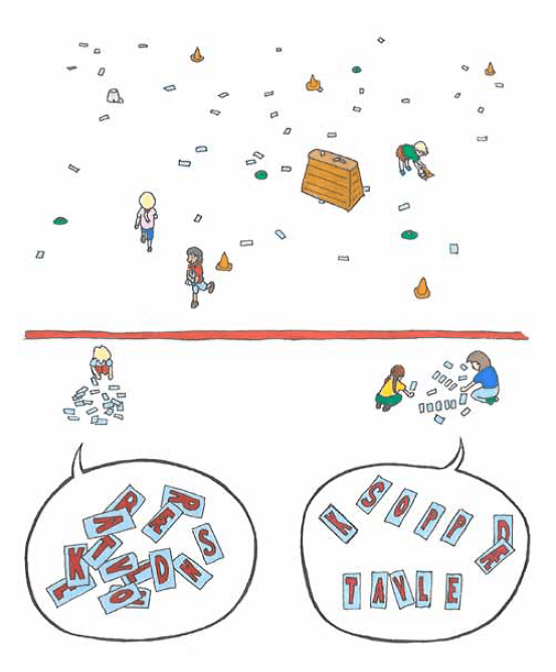
Collect as many letters as possible within a given timeframe, then form words with them.
- 6-15 years
- Group size: 3+
- Duration: 30 min
- Physically Active Learning
- Gym / Sports hall
- Indoor
- Open space
In this activity, participants are to collect as many letters as possible within a specified timeframe. Once time is up, they use the letters they have collected to form words. This part can also be time-limited, or participants can be allowed to continue until they have made as many words as they can.
Tip: Use laminated letters, letter blocks, or Scrabble tiles.
Preparations
The letters are placed in the area before the start. This can be done in various ways:
- placed openly in a clear area
- hidden in a more cluttered environment, for example
There should be many letters available, so that participants can spend several minutes searching and collecting. Participants line up behind a starting line and wait for the start signal.
How to Play
At the start signal, all participants run out simultaneously to collect letters. They must follow these rules:
- They can only collect one letter at a time.
- Each letter must be brought back to the team area before they can run out again.
- The activity continues this way until time is up.
When time is up, the teams gather their letters and move on to the next part of the task: forming words. Here, you can choose between giving a new, fixed timeframe for word building, or letting the teams continue until they can no longer form any more words.
The winner can be the team that:
- creates the most words
- uses the most letters
- meets other criteria agreed upon in advance
Tasks can be varied according to age and level. Examples of categories:
- proper nouns
- animals living in the forest
- tree species
- other theme-based words (for example, «kitchen items», «words about winter», etc.)
Variations
The activity can easily be adapted for different groups:
- done individually or in teams
- younger children can work as a group and collaborate on the task
- letters can be replaced with numbers if you want to practice math, for example by:
- creating equations
- combining number sequences
For the youngest or less experienced, simple and concrete categories can be chosen, gradually increasing both difficulty and academic content as participants become more confident and experienced.